

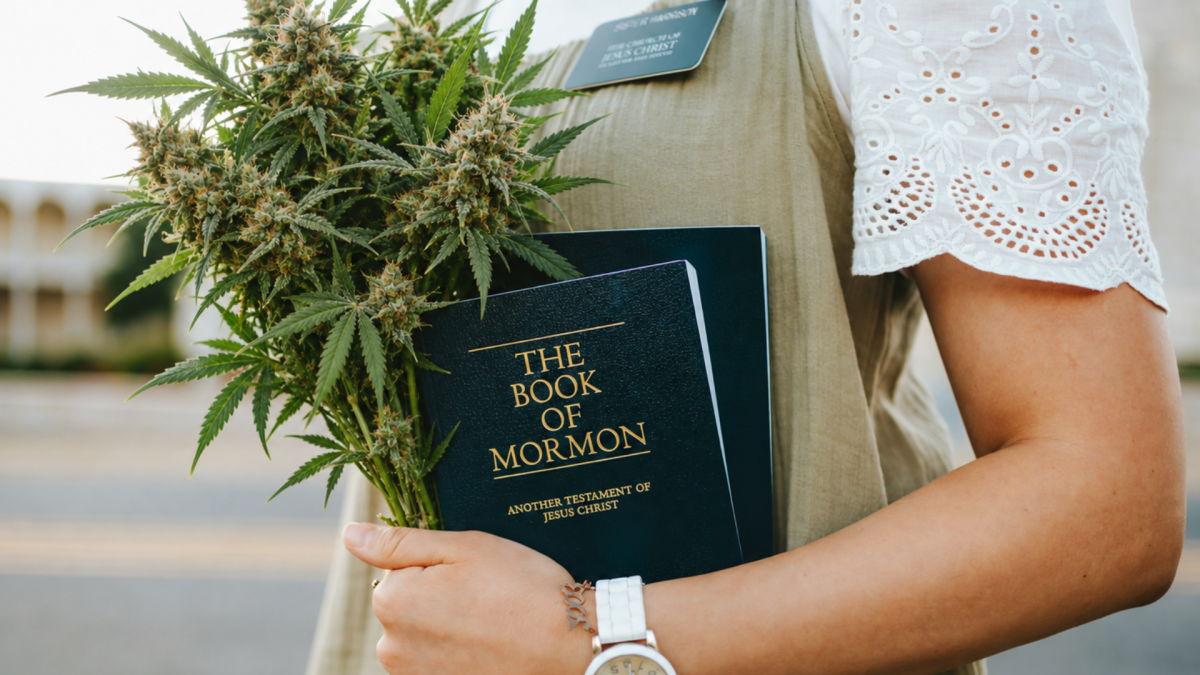
Mormon Wives star Mikayla Matthews says medical cannabis was “literally life-changing” for her nerve pain and sleep, bringing weed into a show already built around the tensions between modern Utah life and Mormon expectations. But the Church’s position is more nuanced than a simple prohibition.
Mikayla Matthews, one of the stars of Hulu’s The Secret Lives of Mormon Wives, has opened up about using medical cannabis for severe nerve pain and to help her sleep, calling the experience “literally life-changing,” according to Green State.
In the season five premiere, Matthews visits a Utah dispensary with her husband, Jace Terry, where she speaks with a pharmacist and looks through different products. Matthews has said she suffers from Chronic Inflammatory Response Syndrome, or CIRS, a condition that has left her dealing with painful symptoms.
“It was mainly just for sleep at first,” Matthews says in the episode. “I had debilitating nerve pain through my whole body.”
Then came the moment that has attracted attention well beyond the reality-TV universe.
“The first time I tried it, it was literally life-changing,” she says. “It was the only thing that had ever taken away my nerve pain, and I’m finally well-rested.”
For a show with “Mormon” in its title, a dispensary trip might sound like an obvious act of religious rebellion. The reality, however, is considerably more complicated.
Actually… The Mormon Church Doesn’t Ban All Medical Cannabis

Matthews was raised in the Church of Jesus Christ of Latter-day Saints, commonly known as the Mormon Church, although she has said she has not been an active member for around a decade.
The Church is famously associated with the Word of Wisdom, its health code, which restricts substances like alcohol, tobacco, coffee, and tea. Adult-use weed also falls outside what the Church considers acceptable. But… medical cannabis is a different matter.
Current Church policy explicitly distinguishes between recreational and medicinal use. The Church opposes cannabis for non-medical purposes but permits it when administered under the direction of a competent physician.
That makes Matthews’ dispensary visit less doctrinally explosive than it may initially appear. She is using cannabis within Utah’s regulated medical system and discussing it as a way to manage physical symptoms, not simply as an intoxicant.
Matthews herself appeared uncertain about the distinction on the show. “I assume that the Church doesn’t like marijuana, but they also didn’t like soda,” she joked.
The soda comparison is particularly telling in a Mormon context. Coffee and tea remain prohibited under Church teachings, while caffeinated soda does not—a distinction worth noting when considering Utah’s celebrated “dirty soda” culture.
The Mormon Church Helped Shape Utah’s Medical Weed Laws
The Church’s acceptance of medical cannabis does not mean it embraced legalization without reservations.
Utah became a major battleground over medical cannabis in 2018, when voters considered Proposition 2, a ballot initiative that would have established a statewide medical program.
Church leaders opposed the proposal, arguing that it was too permissive and did not contain sufficient safeguards around distribution, dosage, and access. At the same time, Church officials repeatedly emphasized that they did not oppose cannabis as medicine in principle.

Instead, Church representatives, lawmakers, medical organizations and cannabis advocates eventually negotiated a more restrictive compromise.
Utah voters nevertheless approved Proposition 2 with roughly 53% of the vote. Shortly afterward, state lawmakers replaced much of the initiative with the negotiated medical cannabis framework during a special legislative session.
The debate also showed that ordinary Latter-day Saints were hardly united against medical weed. Polling before the vote showed substantial support for legalization among Church members, although opposition increased among highly observant members after Church leadership publicly campaigned against the initiative.
So, medical cannabis had already been part of the conversation within Mormon communities for years before a Mormon Wives camera entered a dispensary.
‘Mormon Wives’ Has Always Been About Where the Rules Bend
The Hulu series follows members of MomTok, a group of Utah-based mothers and influencers whose relationships with Mormonism range from active religious participation to cultural identification and outright distance from the Church.
The show became a hit largely by leaning into that contradiction. Its cast navigates sex, marriage, divorce, drinking, therapy, cosmetic procedures, and Mormon expectations while constantly debating which rules still matter to them. Now cannabis enters that conversation.
The series has previously featured medical or wellness-oriented use of substances including ketamine and nitrous oxide, creating an unusual contrast with a religious culture that strongly discourages intoxication, but Matthews’ experience may be the clearest cannabis example yet.
She even tells viewers that, amid the stress surrounding the series and MomTok drama, cannabis has been “fixing everything.”
Photo by Bailey Burton on Unsplash // Edited with AI