A federal docket on the therapeutic use of psychedelics is open through October 5. Four groups that built this movement from the ground up on what they’d tell the government, what they’re fighting in court, and how much of their work the docket doesn’t cover.
The Food and Drug Administration held a public hearing on the potential therapeutic uses of psychedelic drugs on September 14. The part that is still open is the written comment period, which runs through October 5 under docket FDA-2026-N-7542, and anyone can file to it.
Britton “Britt” Rollins, co-founder of the Oregon-based National Psychedelics Association, wants people to use it. “We’re asking that anyone who has experienced psilocybin or seen the benefits of psilocybin-assisted therapy should make their voices heard during this open-comment period,” he says.
Worth knowing before you write: the notice is narrower than the invitation. The FDA framed the proceeding around the therapeutic use of a range of psychedelic compounds, not psilocybin specifically, and said it is not seeking comment on legalization, decriminalization, the merits of state or local programs, or religious, ceremonial or personal non-medical use. A comment that simply argues mushrooms improved someone’s marriage falls outside what the agency says it is seeking. A comment about clinical evidence, trial design, safety monitoring, practitioner training and credentialing, or barriers to therapeutic access does not.

The hearing did not come out of nowhere. On April 18, 2026, President Trump signed Executive Order 14401, “Accelerating Medical Treatments for Serious Mental Illness.” It directs the FDA to give priority-review vouchers to qualifying psychedelic drugs that already hold Breakthrough Therapy designation, directs the FDA and DEA to establish a Right to Try pathway for eligible patients, and orders HHS, through the Advanced Research Projects Agency for Health, to allocate at least $50 million in existing funds to partner with state governments that have enacted or are developing psychedelic programs for serious mental illness. Rollins takes it as a win regardless of who signed it. “We should be optimistic that the federal government and the executive branch are interested in the healing powers of psychedelics,” he says. “I do think we should hold that up as a win because we’ve not seen that happen before; we’ve never had an executive branch that’s gone this far in that lane.”
The Patients Who Can’t Get to the Center
The NPA’s other fight is in Oregon, and it is the sharpest example of how a law can be permissive and exclusionary at the same time.
Oregon voters passed Measure 109, the Psilocybin Services Act, in November 2020, creating the country’s first state-authorized framework for supervised psilocybin. The catch is in the architecture: legal use has to happen at a licensed service center. A federal lawsuit, Cusker et al. v. Oregon Health Authority, argues that requirement violates the Americans with Disabilities Act by shutting out homebound and hospice patients who physically cannot travel to one.
“Currently, as the law reads, anyone must go to a service center to obtain services, but if a patient is in hospice care or homebound, they’re not mobile, so you can see what a problem that is,” Rollins says. “So under the Americans with Disabilities Act, we felt this is a population that could benefit the most and really deserve to have this treatment to improve their last days.” The NPA supports the case, which largely survived Oregon’s latest attempt to end it in March, when a federal judge allowed the ADA claims brought by three licensed facilitators to proceed.
Colorado followed Oregon in 2022 with Proposition 122, the Natural Medicine Health Act, which decriminalized adult cultivation, possession and sharing of psilocybin mushrooms and allowed for healing centers. Those are now open. New Mexico’s health department says it aims to enroll its first patients by the end of 2026.
Rollins says the NPA does not advocate for one route over another. “The NPA does what we call the ‘Continuum of Care,’ which means we are not here only to advocate for one path towards access over all others,” he says. “We recognize that different individuals have different needs and different comfort levels. Spiritual and ceremonial use may not be for everyone, just as everyone may not have a (medical) indication to warrant an FDA medication (approval). And just because neither of those avenues fit some people does not mean they should be denied access at all.”
The NPA also builds financial services for psilocybin programs, a line of work that predates the advocacy. Rollins says the group formed in 2020, as Oregon prepared to vote, precisely because the founders expected licensed programs would need providers who could serve them nationally.
Grow, Gift, Gather

Two thousand miles north, in a state that still prohibits psilocybin outright, the Port Townsend Psychedelic Society is making an argument about where this movement should not go.

PTPS started in 2019, and co-founder Erin Reading traces it to a city council vote 800 miles south. “My good friend Rebecca Elatiki and I independently heard about that resolution passing in Oakland and were inspired to do something similar locally,” she says, referring to the June 2019 Oakland resolution that decriminalized psilocybin and other naturally occurring psychedelics. “We both reached out to Decrim Nature Oakland. We soon joined forces to pursue resolutions achieving de facto decrim of natural psychedelics at the city and county levels. We also provide education and community support to complement those efforts, and hence the Port Townsend Psychedelic Society was born in 2019.”
The model they built has a name, and it is a deliberate hedge against the industry the rest of this story is describing. “The ‘grow, gift, gather’ model helps protect such psychedelics from commercialization and commodification by encouraging people to grow their own natural psychedelics, which in our area mostly involves growing psilocybin,” Reading says. “This is a way to deepen one’s relationship with the fungi, provides a safe access source, especially with all the sketchy products currently sold in smoke shops and online, and helps build community.”
The detail she offers next is the one that sticks. “Where we live, a large portion of the folks growing their own mushrooms are older, retired folks, which is super inspiring.”
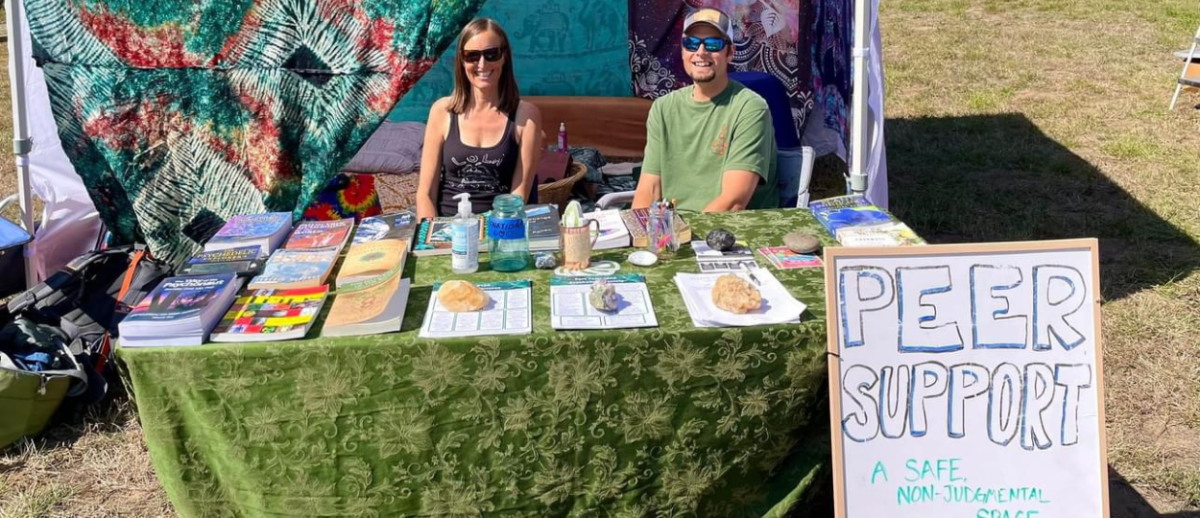
Growing psilocybin mushrooms remains illegal under Washington state law, where psilocybin is a Schedule I controlled substance. PTPS does not distribute them; it produced a Psychedelic Exchange Best Practices document laying out ethics and safety guidelines for the model, and it runs peer support tents at regional festivals. The group is now working on a curriculum for young adults on safe engagement with psychedelics, and partnering with two other societies on the greater Olympic Peninsula to build a practitioners’ guild and an ethics council.

From Psychedelic Society to Psychedelic Profession
The San Francisco Psychedelic Society was founded in December 2011 by Daniel Jabbour, first as a Facebook page and a meetup. The organization describes it as the first psychedelic society of its kind. Jabbour died two years later, and stewardship moved around until Danielle Nova took it over in 2018.

“There weren’t any other psychedelic societies; very few people were gathering publicly to discuss psychedelics; all the conversations were behind closed doors,” Nova says of the early years. “We are an evolutionary healing community dedicated to psychedelic education, harm reduction, integration, decriminalization advocacy, and creating supportive spaces for personal growth, transformation, and healing.”
SFPS has also raised money for and provided reciprocity to Indigenous communities in South America, including leaders of the Yawanawá, Huni Kuin, Shipibo, Wixárika and Noke Koi.
Nova is executive director of SFPS, the nonprofit, and separately the founder and owner of Lumeria, the for-profit company that runs the microdosing courses and the facilitator training. The two are easy to conflate and worth keeping apart.
The training is where the commercial side becomes clearest. “In our training program, we have world-renowned microdosing clinicians, researchers, and trainers. We train clinicians, healthcare professionals, entrepreneurs and other practitioners how to ethically and safely guide clients through microdosing protocols, and how to create microdosing facilitator businesses,” Nova says. SFPS also runs two paid courses on how to microdose, developed in partnership with Dr. James Fadiman, who established the protocols the modern microdosing movement runs on.

What she says the training is for goes further than the evidence does. “I teach both the (future) facilitators and my personal clients how to use microdosing as a tool of neuroplasticity and behavior change, so that they can actually change their baseline and change their lives through the intentional use of microdosing,” Nova says. That is her characterization of the practice. Controlled research on microdosing remains limited and mixed: some placebo-controlled studies have found measurable effects, others have found little or no sustained benefit, and no regulator has approved microdosing for any condition.

“Thirty-One Flavors of Psychedelics”
On the East Coast, where no state has decriminalized, Psychedelic Sangha has spent seven years building something that does not depend on the law changing at all.

Psychedelic Sangha was founded in 2018 by Doc Kelley, Erik Davis and Ethan Covey. Kelley, its director of operations, traces it to an event that year at the Rubin Museum of Himalayan Art, where the group experienced the museum as a temple. That became “Flux Buddha,” and by 2019 they were staging what they call happenings at a Greenpoint venue, built around Tibetan Buddhist practice inside an immersive sensory environment. The Rubin closed its Chelsea building in 2024 and now operates without a permanent home.
“Our ‘Psychedelic Buddhism’ events are held in safe spaces in public,” Kelley says. “We don’t distribute psychedelics, and we don’t even encourage people to take them; we value the sober states you get from meditation as well as what you get from psychedelics.”
The group’s paid offerings include a speaker series and a cohort program that builds toward a three-day retreat. “As a group, we ceremonially take psychedelics, and people meditate every single day independently,” Kelley says. “Then we come together on Zoom and/or in person to deepen what each person is doing privately. All this leads up to a psychedelic three-day retreat where everybody comes together in person. One year, we held our retreat on a massive Gatsby-like estate on Long Island. So it’s like one of our soundbaths, but it’s way more intimate, and everybody’s on the same substance. There’s a musician, a meditation guide, and psychedelic facilitators present to help people during a bad trip.”
Asked how that squares with a group that says it doesn’t distribute or encourage, Kelley draws a line between the two formats. The public events are ticketed and open, and he describes the standard there as harm reduction: a safe space for people to exercise cognitive liberty within ethical boundaries. The retreat is the opposite of open. Applicants submit their mental and physical history along with their psychedelic and meditation history, and a psychiatrist on staff helps him conduct Zoom interviews with candidates. There is a four-week sober practice program before anyone gets there.
Nobody hands out anything at either one, he says. “Participants are directed to a safe source we have vetted. So even in the private retreat, we don’t distribute directly. So basically it’s BYOD, bring your own dose.” The group does make dose recommendations, calibrated to whether the person is a newcomer or, in his word, a psychonaut.
Kelley’s worry about where all of this is heading is not about law enforcement. It’s about flavor.
“What concerns me about where we’re going is with this hedonic sort of orientation; the lights and phantasmagoria becoming central to the psychedelic experience,” he says. “Also with the legalization and normalization of psychedelics, along with capitalism mixed in there, I think we’re going to see psychedelic experiences that don’t challenge your psyche. It’ll become like ’31 Flavors’ of psychedelics: ‘Ok, what do I want to feel tonight? I want to feel the good part of LSD, but not the bad part.’ And you can order it from a drug version of ‘DoorDash,’ and they bring it to your front door.”
He laughs when he says it, then adds the part that isn’t a joke. “And that’s fine; who am I to tell you not to do that? But what Psychedelic Sangha presents is a different space where you’re utilizing the body and sensory experiences, but it’s combined with this other discipline.”
Until October 5
Four groups, three states, two coasts, and not much agreement about what comes next. Rollins wants a continuum of legal routes and a court order for hospice patients. Reading wants people growing their own before anyone can sell it to them. Nova is training a professional class to guide it. Kelley is trying to keep it difficult.
What they share is that all of them built what they built while these substances were federally illegal. Now the FDA has opened a federal conversation about one part of that world: therapeutic use in supervised settings. Much of what these groups built sits outside the docket entirely. It closes October 5.
Where to find them: National Psychedelics Association, Port Townsend Psychedelic Society, San Francisco Psychedelic Society, Psychedelic Sangha. The FDA docket is at regulations.gov.
Editor’s note: several of the organizations in this article sell courses, trainings or services related to the practices described. Those are identified where they come up. Nothing here is medical or legal advice. Psilocybin remains a Schedule I substance under federal law, and cultivation and possession remain crimes in most states.